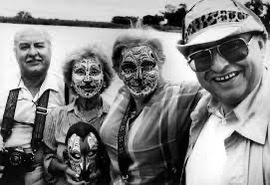
One of the most volatile, provocative, and eye-opening documentaries I have ever seen is the 1988 work by anthropology film maker Dennis O’Rourke titled, “Cannibal Tours.” The documentary deals with the commodification of culture and the colonial erasure that ensues in Papua New Guinea as European and American tourists visit the area out of curiosity of the traditional cultural lifestyle practiced there, as well as the morbid curiosity of the people’s storied history of cannibalism in the years of fighting against German colonists.
“Cannibal Tours,” is a profound documentary that brings up some interesting questions about the pursuit of ground-breaking educational content in culturally rich lands. O’Rourke structures and frames this documentary to present the white European tourists as the “cannibals of culture.”
Cannibalism in the title is in no way referencing the history of the tribes of focus in Papua New Guinea. This tactical switching of framing in the film by O’Rourke is done in quite a few masterful ways.
Early on in the documentary, O’Rourke captures a conversation with a French family as their large white boat lazes down the Sepik River in Papua New Guinea. The family is referring to the local people as “primitive savages,” and “uncivilized,” yet maintaining their apparent admiration for the culture. This clip directly cuts to an interview with the local tribe chief, who says that his parents and ancestors originally believed that the advanced German boats and weaponry that appeared on the banks of their rivers during colonial times were originally thought to be the ghosts of their dead ancestors with pale white skin. As a result, the modern people of Papua New Guinea refer to these modern tourists as the ghosts of their ancestors. This is a fascinating juxtaposition right off the bat, because we essentially see the tourists and the local tribes referring to each other in the exact same terminology as these groups of people used a half a century prior.
A poignant line drawn in the documentary is that it portrays how the people of Papua New Guinea are slowly having their culture torn apart and reprocessed by these “cannibal tours.” The tribal people lament to O’Rourke that they can tell the tourists have money, likely spent thousands of dollars to travel across the world to get to their home, and when they arrive they attempt to auction off the local art and pay them dirt cheap prices for their original and cultural pieces of art.
A shocking bit of dialogue in the documentary comes from an American art enthusiast who was inspired to go to Papua New Guinea after Michael Rockefeller disappeared in his travels there. She delves into an ignorant tangent about being fascinated by the primitive culture of the land, yet she was disappointed to see that they were trying to appease tourists and sell their art. This was quite disheartening to see. The tourists don’t realize the disregard for humanity they establish when they wander about sticking cameras in the faces of people just trying to live their lives in a foreign land, yet they establish a superiority complex once the local people try to just slightly benefit off of their unwanted visitors.
The quote at the beginning of the “Cannibal Tours” film does a wonderful job of describing the intentions of the film maker. It reads:
“There is nothing quite so strange in a strange land, as the stranger who visits.”
An interesting question arises when watching O’Rourke’s documentary. Is the pursuit of academic prowess through presenting a critical lens of the whitewashing of primitive culture not a form of cultural cannibalism in itself? O’Rourke was essentially in the same position as these tourists, opting to make their cultural dissonance the aim of his camera’s story. What separates O’Rourke from the others? I believe the answer is his objectivity to the situation. His intentions are pure and his camera angles express disdain for the crude vulture-like tourists roaming about New Guinean villages in designer clothes, mosquito nets, and golden jewelry.
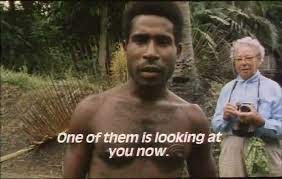
I believe that O’Rourke’s film does a profound job of dissecting how evident and real the roots of colonialism still are across the world and how uncomfortable the commodification of culture is to witness first hand. The local people of Papua New Guinea charge the tourists 2 dollars per camera to take pictures within their Spirit House, a building with religious and historical prowess in their society. This was quite disturbing because the locals explain that all of the items of spiritual power and historical importance were destroyed and stolen by colonizers decades prior and now those colonists’ ancestors are paying 2 dollars to take a picture of an empty and destroyed place of cultural significance.
In a 1996 New York Times article, author Caryn James cites film director O’Rourke as saying about his film,
“These bourgeoisie tourists have bought the packaged version of ‘Heart of Darkness.’”
I too drew quite a few connections between this real life portrayal of neo-colonialism and the old short story from Joseph Conrad. Both depict a gnashing, cannibalistic journey down African rivers to poach and intrude upon the depths of foreign cultures.
Billy Woods, a poet and hip-hop artist who grew up back and forth between South Africa, Jamaica, and Brooklyn, has a record titled Aethiopes in which he draws parallels between the commodification of culturally primitive lifestyles practiced in many places in Africa with the futility and despair that often comes with the experience of being Black in America that is eventually re-wrapped represented in a way that glorifies violence and street life for those who have never experienced it. Woods references this film “Cannibal Tours,” on the third track of Aethiopes titled “Wharves.” A brief excerpt from the first verse of this track is quite profound, Woods says,
“Salt in the mouth of the river
Mangrove thickets, man’s soul was broken mirrors
False witness, wolf tickets
Nowadays scavengers come before the wolf’s finished.”
There are many ways to interpret the dense writing that Woods puts into his work, however on this track he is essentially accomplishing the same thing as the “Cannibal Tours” documentary by flipping the imagery of savagery from the locals and pinning it onto the Europeans who are blindly tearing down cultural boundaries and feasting on culture out of morbid curiosity. The last line quoted is a contemplation on how the scavengers (modern neo-colonial tourists) are now back in lands like Papua New Guinea before the effects of the wolf (German colonialism) have even fully run their course on society.
The repeated chorus of Woods’ track Wharves:
“Cannibal tours, they came on all fours,
Waterborne, eyes like jaws.”
This line directly mirrors the juxtaposition O’Rourke establishes in his documentary when he cuts between shots of the tourists’ boat grimly sliding down the Sepik River with shots of crocodiles lazing in the midday sun. The local tribe chief interviewed in the documentary notes that their ancestors named the colonist ships after their crocodile spirit.

 The First Spin